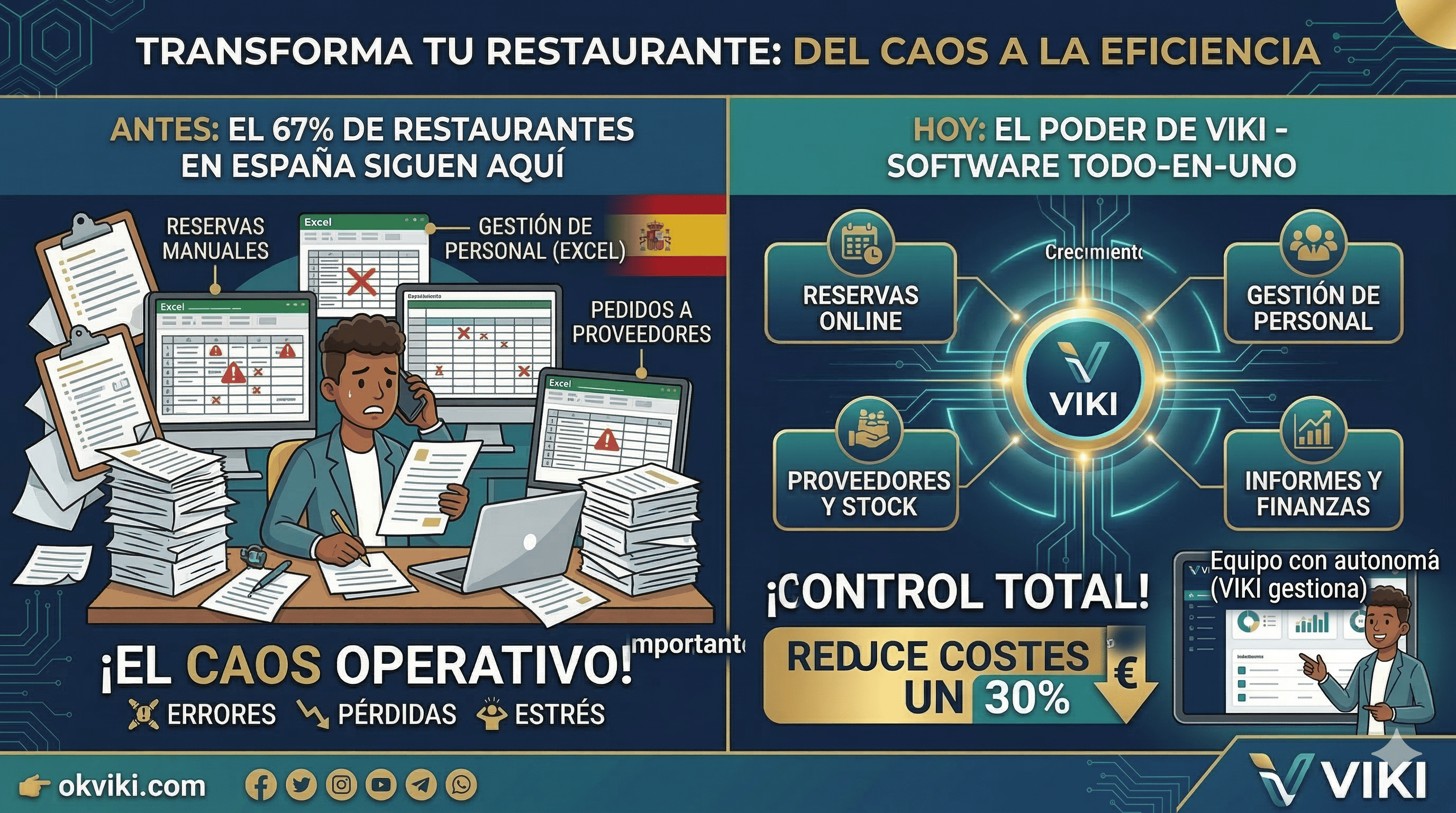
Hospitality is Spain's third-largest economic sector, with over 315,000 active establishments and annual revenue exceeding €130 billion (INE, 2025). Yet it's also one of the most digitally lagging sectors: according to Hostelería de España, 67% of restaurants manage reservations, staff, and suppliers with spreadsheets or notebooks.
In this article, we analyze the specific challenges of hospitality, the features management software needs in 2026, and how an all-in-one platform can reduce operational costs by up to 30%.
The 5 biggest management problems in hospitality
1. Fragmented shift and staff management
The average restaurant has between 8 and 25 employees on rotating shifts. Without a centralized system, scheduling conflicts consume an average of 6 hours per week of the manager's time. Paper schedules or WhatsApp groups generate errors, uncovered absences, and staff turnover.
2. Reservations disconnected from operations
42% of restaurants simultaneously use 3+ reservation channels (phone, Google, TheFork, Instagram DM) without synchronization. Result: overbooking, empty tables from no-shows, and an estimated loss of €800-1,500/month per restaurant.
3. Non-existent cost control
Only 23% of restaurants calculate their real food cost weekly. Most discover profitability problems when the accountant's bill arrives, months later.
4. Reactive marketing, not strategic
78% of restaurants post on social media "when there's time." No editorial calendar, no metrics, no strategy. Result: inconsistent digital presence that doesn't generate reservations.
5. Multiple disconnected tools
The typical restaurant uses: POS + reservation book + Excel for schedules + WhatsApp for suppliers + accountant for invoices + Canva for social media. Total cost: €200-500/month plus hours lost manually syncing data.
What features does hospitality software need in 2026?
| Feature | Impact | Do typical tools include it? |
|---|---|---|
| Employee & shift management | Saves 6h/week for the manager | Dedicated apps only (€30-50/mo) |
| CRM with customer history | +25% repeat visits | Generic CRMs, not adapted |
| Billing & cost control | Detects losses instantly | Separate accounting software |
| Editorial calendar & social media | Consistent digital presence | Disconnected tools |
| WhatsApp Business with AI | 24/7 reservations without staff | Not available in hospitality software |
| Employee time tracking | Legal compliance + control | Dedicated apps (€15-30/mo) |
| Projects (renovations, events) | Structured planning | Not available |
| Strategic AI | Data-driven decisions | Not available |
Case study: Restaurant with 40 covers
Before (without unified software):
- Manager spends 12h/week on admin
- 3 different tools (€270/month)
- Uncontrolled no-shows: €1,200/month loss
- Social media posts: 2-3 per week, no strategy
After (with all-in-one platform):
- Admin reduced to 4h/week
- 1 platform (€399/month, everything included)
- Automatic WhatsApp confirmation: no-shows reduced by 60%
- AI editorial calendar: 5 posts/week programmed automatically
- Estimated net savings: €590/month
Frequently Asked Questions (FAQ)
How much does restaurant management software cost in 2026?
Prices vary by approach: a POS costs €30-80/month, a CRM €50-150/month, and a staff management tool €15-50/month. Adding all necessary tools together, the total cost is around €200-500/month. An all-in-one platform like VIKI starts at €399/month and includes all features.
Does a small restaurant need a CRM?
Yes. Knowing your regulars' preferences (favorite table, allergies, visit frequency) increases repeat rate by 25% according to Harvard Business Review. You don't need a complex CRM — you need one integrated into your daily management tool.
Can AI manage reservations via WhatsApp?
Yes. AI chatbots with natural language processing can handle reservations, confirm attendance, send reminders, and answer FAQs (hours, daily menu, allergens) 24 hours a day, 7 days a week, without human intervention.
How long does implementation take?
A modern platform is implemented in 1-2 weeks. The first week is dedicated to setup (employees, menu, suppliers) and the second to team training. From the third day, you can already manage shifts and customers.
Conclusion
Spanish hospitality has a huge opportunity to improve margins through digitalization. The tools exist, costs have been democratized, and results are measurable from the first month. The question isn't whether to digitalize your restaurant, but how much you're losing each month by not having done it already.